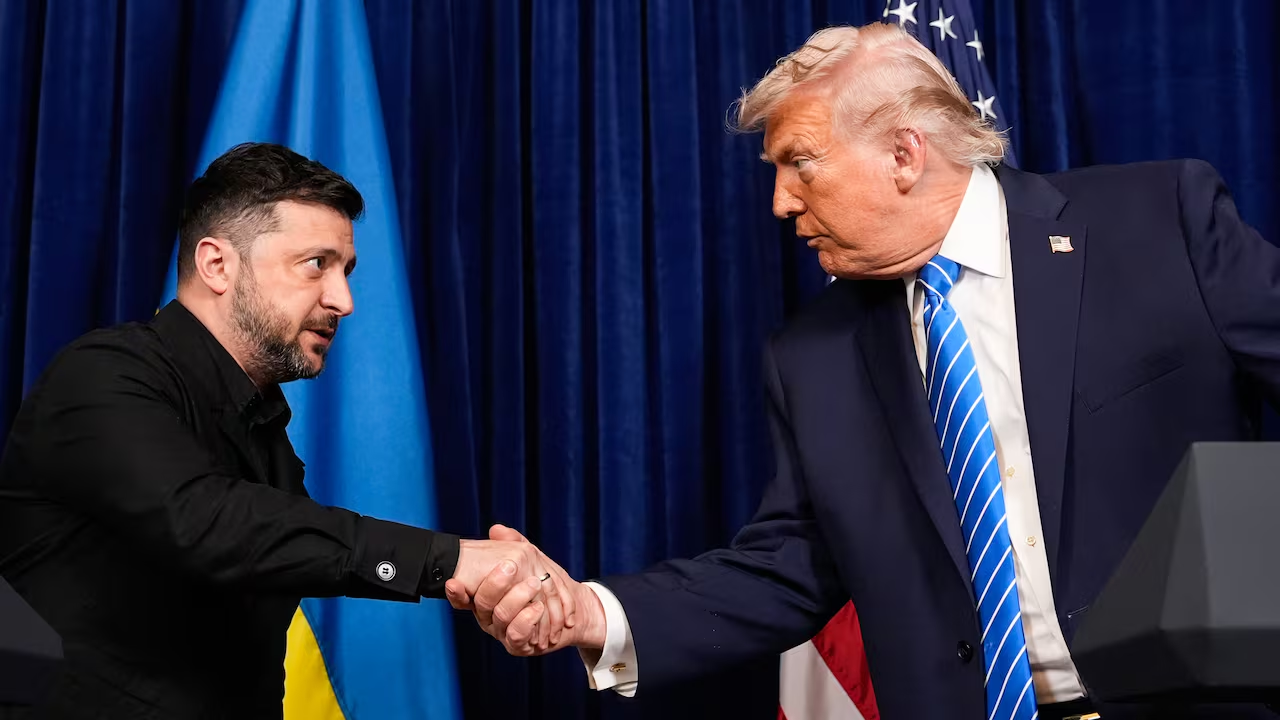
As the clock struck midnight on New Year’s Eve 2025, millions of Ukrainians tuned in to hear their president, Volodymyr Zelenskyy, deliver a message they’d been waiting years for. In a heartfelt 20-minute address from Kyiv, Zelenskyy revealed that a peace agreement to end the nearly four-year war with Russia is “90% ready.” It was a moment that sparked cautious optimism around the world – could 2026 finally bring an end to the bloodshed?
I’ve followed this conflict closely since it escalated in 2022, and like many, I’ve felt the emotional rollercoaster of dashed hopes and fleeting glimmers of progress. Remember those early talks in Istanbul? Or the grain deal that briefly eased global food shortages? Each time, expectations rose, only to crash against the reality of entrenched positions. Zelenskyy’s words this time felt different – grounded in recent high-level diplomacy – but they also carried a sobering warning: the remaining 10% is the hardest part.
Zelenskyy didn’t sugarcoat it. He said the final pieces would “determine the fate of peace, the fate of Ukraine and Europe.” Ukraine, he stressed, wants peace – but not “at any cost.” Not if it means the end of Ukraine itself.
What Zelenskyy Actually Said in His New Year’s Address
The address was classic Zelenskyy: defiant yet hopeful, personal yet statesmanlike. Seated in his office with a modest Christmas tree in the background, he spoke directly to his people, many of whom were huddled in shelters or enduring blackouts from Russian strikes.
He began with raw honesty: “I would give anything in the world if, in this address, I could say that peace will also come in just a few minutes. Unfortunately, I cannot say that yet.”
But then came the bombshell: After grueling talks, including a recent trip involving nearly 50 hours on the road and meetings with U.S. officials, a peace framework is largely in place. The U.S. has offered 15-year security guarantees, though Zelenskyy pushed for longer. Intentions, he said, must become ratified commitments – no flimsy papers like the Budapest Memorandum, which failed to protect Ukraine in 2014.
He rejected weak deals that “only fuel war,” referencing past failures like the Minsk agreements. And he directly called out Russia’s demands for full control of Donbas as deceptive: “Withdraw from Donbas and everything will end? That’s a lie.”
The Context: A Flurry of Diplomacy Heading into 2026
This claim didn’t come out of nowhere. Late 2025 saw intense U.S.-led shuttle diplomacy under President Trump, who has repeatedly vowed to end the war quickly.
Key developments:
- Zelenskyy met Trump at Mar-a-Lago just days before the address.
- Trump’s envoy, Steve Witkoff, held talks with European and Ukrainian advisors.
- A revised peace plan emerged, focusing on security guarantees, reconstruction, and de-escalation mechanisms.
- European leaders, including France’s Macron, pledged concrete commitments at an upcoming Paris summit on January 6.
Trump himself has been optimistic, once saying the deal was “closer to 95%.” But analysts note the gap: Russia remains inflexible on territorial control, especially Donbas, where it holds most of the region.
Key Sticking Points in the Negotiations
| Issue | Ukraine’s Position | Russia’s Position | Status |
|---|---|---|---|
| Territorial Control | No concessions on occupied lands; referendum possible with ceasefire | Full control of Donbas and other regions | Major obstacle; Russia unwilling to budge |
| Security Guarantees | Binding, ratified commitments (e.g., U.S./EU troops or aid) | Rejects NATO/Western presence | U.S. offers 15 years; Ukraine wants more |
| Ceasefire | Immediate, to enable referendum/vote | No ceasefire without concessions | Stalled |
| Reconstruction | International funding, no Russian veto | Demands lifting of sanctions | Discussions ongoing |
These aren’t minor details – they’re the core of why peace has eluded grasp for so long.
Pros and Cons of the Emerging Peace Framework
Any deal will face scrutiny. Here’s a balanced look:
Pros:
- Potential end to daily deaths and destruction.
- Security guarantees could deter future aggression.
- Economic recovery for Ukraine, with international aid.
- Broader European stability.
Cons:
- Risk of legitimizing Russian gains without full withdrawal.
- Weak enforcement could invite renewed invasion.
- Domestic backlash in Ukraine over any concessions.
- Russia’s history of violating agreements.
From what we’ve seen, this plan leans toward strong guarantees to address Ukraine’s fears – a lesson from past betrayals.
Reactions from Around the World
Russia’s response was predictably cool. Putin’s brief New Year’s speech focused on “victory” for troops, avoiding peace talks altogether.
In the West:
- EU diplomat Kaja Kallas called Russian distractions (like alleged drone plots) deliberate sabotage.
- Macron promised “concrete commitments” for Ukraine’s protection.
- Trump advisers emphasized deconfliction to prevent restart of war.
Skeptics, including some analysts, argue the “90%” figure is diplomatic positioning – pressuring Russia while rallying support.
People Also Ask: Common Questions About Zelenskyy’s Claim
Here are real questions popping up in searches, with straightforward answers:
Is a Ukraine-Russia peace deal really possible in 2026? Diplomacy is accelerating, with summits planned for January. But Russia’s maximalist demands make it uncertain – success depends on pressure from the U.S. and Europe.
What are the main obstacles to peace? Territory (especially Donbas), security guarantees, and trust. Russia controls about 20% of Ukraine and shows little compromise.
Will Ukraine accept territorial concessions? Zelenskyy has repeatedly said no to “peace at any cost.” Polls show most Ukrainians oppose major losses.
How involved is the U.S. in these talks? Heavily – Trump administration is brokering, offering guarantees and pushing for quick resolution.
Could this lead to NATO membership for Ukraine? Not immediately; current plans focus on bilateral/multilateral guarantees instead of full NATO.
Looking Ahead: Reasons for Cautious Hope
As someone who’s seen friends in Ukraine endure unimaginable hardship – lost homes, separated families, constant sirens – Zelenskyy’s words hit hard. One story sticks with me: A Kyiv family I know spent last New Year’s in a basement during strikes. This year, they watched the address with tears, whispering, “Maybe this time.”
Humor in dark times helps too – Zelenskyy, the former comedian, has that knack. He sarcastically dismissed Russian lies, reminding us truth matters.
Yet realism tempers optimism. The war enters its fifth year in 2026, with Russia making gains in 2025. Battlefield dynamics could shift talks.
Still, this feels like the closest we’ve been. With U.S. push, European unity, and Ukraine’s resilience, 2026 could mark a turning point.
What do you think – is peace finally within reach, or just another false dawn? The world is watching.